Airport Trolley Designs: High-Traffic Engineering
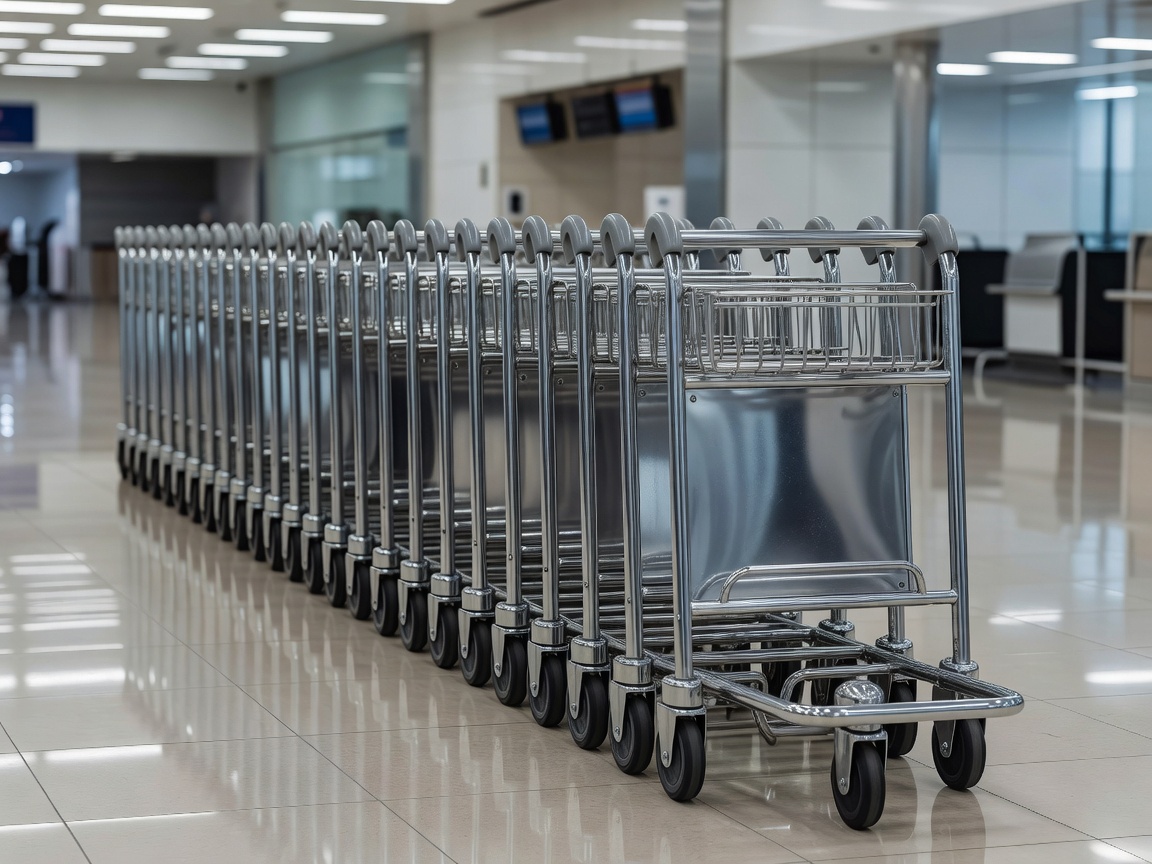
The standard airport baggage trolley is an unsung hero of global aviation logistics. Subjected to continuous, unyielding use by thousands of passengers daily, these units are engineered with a laser focus on durability, safety, and spatial efficiency. Designing a cart that can withstand being rammed into concrete pillars while remaining light enough for a weary traveler to maneuver one-handed is a complex mechanical challenge.
Nesting Geometry
Perhaps the most critical design feature of the airport trolley is its ability to nest. Floor space in an airport terminal is calculated at a premium. If trolleys could not be compacted, they would consume vast tracts of the arrivals hall. Modern designs utilize a tapered frame geometry and a hinged rear basket that lifts up automatically when the nose of another trolley is pushed into its rear. This allows ten trolleys to be stored in the linear footprint of approximately three freestanding units.
The Deadman Brake System
Airport terminals feature ramps, escalators, and curbside drop-offs. To prevent loaded carts from rolling away and causing property damage or injury, aviation regulators mandate integrated braking systems. The industry standard is the 'deadman's brake'. This system defaults to a locked position; an internal spring pushes brake pads against the rear wheels or the axle. The cart will only roll when the user actively presses down on the main handle bar, disengaging the brake. The moment the user releases the handle, the cart stops securely.
Material Selection and Durability
Airport trolleys must endure brutal conditions, including exposure to de-icing fluids, road salt from curbside pickup, and intense UV radiation. Consequently, manufacturers rely on two primary materials:
- Electropolished Stainless Steel: Extremely durable and resistant to scratching and corrosion. It maintains a clean, sterile aesthetic required by high-end transport hubs, though it adds significant weight to the unit.
- Anodized Aluminum Hollow Extrusions: Lighter than steel, allowing passengers to push heavier loads with less effort. Aluminum is naturally rust-proof, though it can suffer from dents if subjected to heavy side-impacts.
Value-Add Features
Beyond the primary load deck, modern trolleys feature upper baskets designed for personal items like briefcases, duty-free bags, and coats. Additionally, the side panels of the main frame and the basket are frequently leveraged as high-visibility advertising real estate. For airport authorities, this advertising revenue often offsets the capital expenditure of purchasing and maintaining the trolley fleet.
Operator Considerations
While designed for passengers, trolleys must be retrieved and repositioned by airport staff. Fleet retrieval is facilitated by towing mechanisms. Many models feature structural tow bars that allow staff, utilizing motorized tugs, to pull 'trains' of up to 20 nested carts from the parking garages back to the baggage carousels safely. The front casters are specifically aligned to prevent the train from 'snaking' at higher speeds.